Announcing Restate BYOC
Restate Team
tl;dr
Today we are announcing Restate Bring-Your-Own-Cloud (BYOC): fully managed Restate with all the features of Restate Cloud,but deployed into your own cloud account and VPC. Private, secure, and up to 10x cheaper than traditional durable execution solutions at high volumes.
This is part of a broader mission we've been working toward since the beginning: Making durable execution a widely usable building block for every app, just like a database.
Restate BYOC is already running in production at multiple customers, including setups exceeding 100k durable actions per second.
The service is initially available on AWS and GCP, with Azure support coming soon. Access to Restate BYOC is on request right now, we expect making it available for public signup in the coming months.
Why we built it
Durable execution was a game changer for almost every piece of backend infrastructure. AI agents, backend workflows, microservice orchestration, event-driven services: everything that runs asynchronously (increasingly large part of every stack) or coordinates across multiple APIs benefits from it. Write the logic, let the runtime handle failures, retries, idempotency, recovery, and get detailed observability and operational tools out of the box. The appeal is obvious, but the adoption curve is steep.
The way Durable Execution was implemented by early systems was designed for expensive workflows. Narrow abstractions (just workflows/activities), requires rearchitecting of app and infra, adds high latency overhead. And at scale it is challenging to run (self-hosting) or expensive to buy (managed services). Restate's mission has always been to change all of that.
Today, we want to look at two challenges in particular:
-
Sensitive data: Durable execution often handles data that flows through your critical paths. Financial records, patient data, sensitive code, internal company information. That is especially important for regulated industries like healthcare and finance, where data residency and privacy are not nice-to-haves but hard compliance requirements. And increasingly, we see fast-growing AI startups with the exact same concerns: the data flowing through their agent pipelines is their customers' data, and it cannot leave the building.
-
It get expensive fast: The broad usefulness of durable functions creates demand for high volumes of executions. We have seen it over and over: users jump onto this paradigm and quickly end up with rates in the thousands of durable actions per second.
But the way durable execution is broadly priced today (as expensive workflow activities at $25-$50 per million) means that kind of volume quickly becomes cost-prohibitive. Durable execution is useful like a database, but priced second only to inference.
The more approachable durable execution is, the sharper these issues become. Restate's lightweight way to define steps, messages, and virtual objects encourages you to use it for more and more of your stack. We see users frequently putting it in the middle of their sensitive infrastructure, and running high volumes on it.
So we built Restate BYOC, to provide fully managed durable execution without hitting these walls.
Enter Restate BYOC
BYOC deploys a fully managed variant of Restate Cloud into a user's own cloud account, in a separate VPC. Think of it as a private region of Restate Cloud, running inside your infrastructure. Users retain full ownership of the compute, storage, and data. BYOC environments can be linked directly to your application VPCs, so that no data ever crosses the public internet.
Restate Cloud receives only system metrics and maintains limited operational access for tasks like upgrades and monitoring. No application data can be accessed by Restate Cloud operators. The result: full data ownership and privacy, combined with the simplicity of a fully managed cloud service. Extended UI and observability, SSO/SCIM, client-side encryption, tunnelling, and all the other features exclusive to Restate Cloud: you get all of it. Without sending a single byte of your data to anyone else's infrastructure.
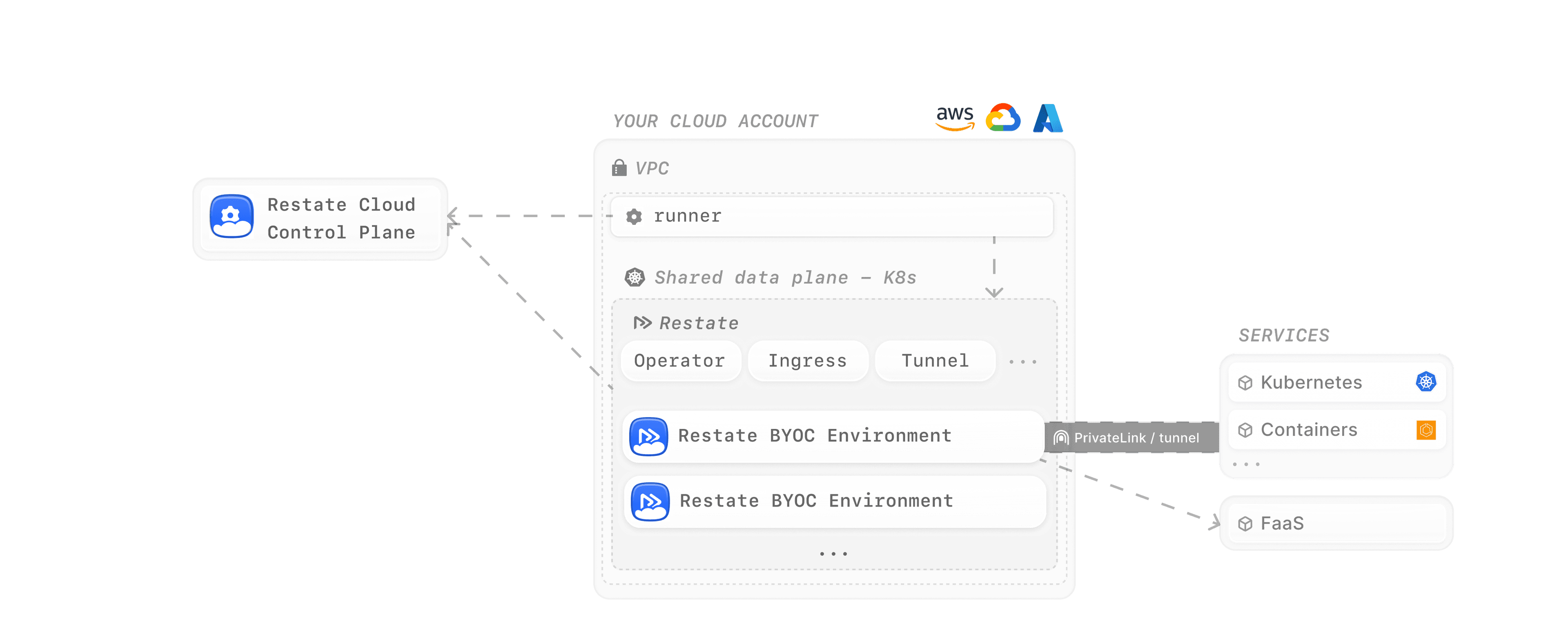
A BYOC environment runs as a private region inside your own VPC, managed from Restate Cloud.
How it works
After signing up for Restate BYOC, you receive a Terraform template. Deploy it in your cloud account (AWS or GCP; Azure in preview) and it provisions a dedicated VPC with a lightweight runner that connects back to Restate Cloud.
The runner brings up the rest of the BYOC stack, creating a private dedicated region that appears in the region selector in your Restate Cloud UI. From there, you create Restate environments just like you would with Restate-hosted public regions, and deploy services, agents, and workflows with private access from Lambda, Kubernetes, or any other compute platform.
Applications communicate with Restate through a private endpoint directly within your VPC. The Restate Tunnel feature lets applications connect to BYOC environments without the need to manage firewalls or configure broad network-based access controls.
On the management side, the BYOC stack makes outbound requests to the Restate Cloud control plane for global metadata and operational metrics. The cloud control plane can send configuration updates through API calls to cloud provider. Finally, the BYOC runner securely polls for and applies software updates. Customers can suspend the runner at any time without affecting running environments.
The whole setup leans heavily on Restate's self-contained design. No external database, no external log, no heavyweight dependency chain. Just an efficient, purpose-built stack. BYOC relies on only a handful of services that are available across all major cloud providers: object storage for snapshots and Kubernetes/containers for deployments.
How we price it
Because BYOC deploys dedicated, single-tenant Restate environments into your VPC, you get optimized deployments of reserved Restate processing capacity. And we price it by that capacity: predictable, transparent, familiar to anyone who has worked with capacity-based pricing on cloud services like DynamoDB, EC2, or RDS.
This reserved capacity model makes BYOC especially cost-efficient at scale. Let's look at two data points:
| Workload (avg) | ~Actions/month | Temporal (activity cost only) | Restate BYOC (all-in) | Advantage |
|---|---|---|---|---|
| 500 actions/sec | ~1.2B | >$32k/mo | ~$6–7k/mo | >4× |
| 5,000 actions/sec | ~13B | ~$300k/mo | ~$30k/mo | ~10× |
A moderate volume deployment of 500 actions/sec (activities/sec) yields about 1.2b activities/month and would cost >32k/month on a platform like Temporal (counting only the activity cost of 25$/million, full cost is probably higher). On Restate BYOC (assuming 1k actions/sec capacity, so a 2x headroom) the cost would be $5k/month in license, plus $1k-$2k for the underlying cloud infra. That's more than 4x more cost effective.
For a high-volume deployment that runs 5,000 durable actions/sec on average (~13b actions/month), an option like Temporal would net around $300k/month on action cost alone. Restate BYOC (assuming 10k actions/sec capacity, so a 2x headroom) the cost would be $23k/month in license, and remain around $30k/month including cost of the underlying cloud infra. A 10x advantage.
See Pricing for more details.
Let's get started!
Restate's mission is to fundamentally change the dynamics of durable execution. Restate BYOC is a part of that mission.
Keep reading
Restate Cloud: SOC 2, Enterprise SSO, and HIPAA
Restate Cloud adds SOC 2 compliance, enterprise SSO, RBAC, client-side encryption, and HIPAA support for security and compliance.
Restate Cloud is Open to Everyone — Build Durable Workflows & Agents Today
Restate 1.4 improves cluster resiliency and workload balancing significantly. Experience less unavailability and achieve more with fewer resources.
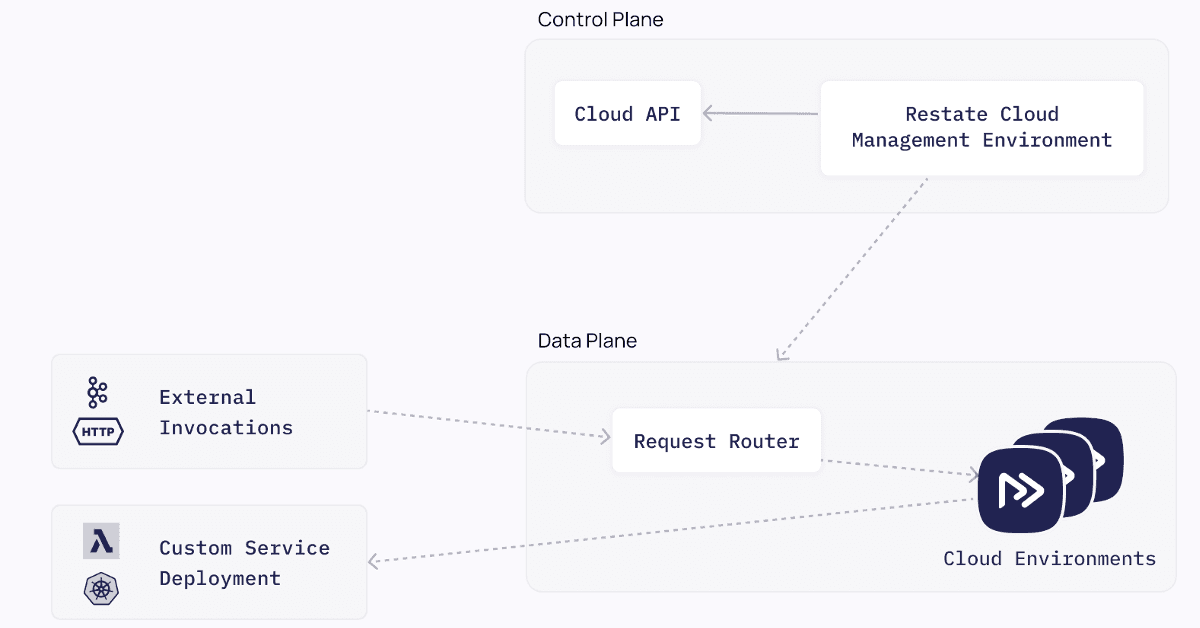
Announcing Restate Cloud Early Access
Today we announce the early access to the free tier of Restate Cloud, our serverless managed Restate offering.